
Science and engineering of polymeric biomaterials
We design biodegradable polymeric biomaterials for implants and tissue regeneration, tuning their mechanical and functional properties.
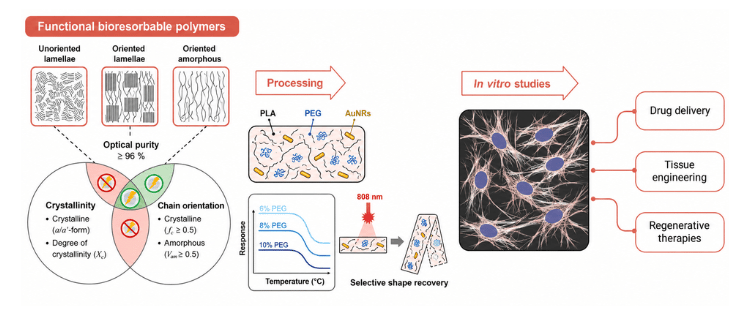
Our research focuses on polyester (co)polymers based on polylactides and polylactones, whose mechanical properties and biodegradation rates can be adjusted through copolymer composition. These materials are oriented towards the development of biomedical implants and scaffolds for tissue engineering, addressing both hard tissue regeneration such as bone, and specific soft tissues — nervous system, urological or cartilage — through polymers with behaviours ranging from rigid glassy to elastomeric.
We employ biofabrication technologies such as 3D printing, stereolithography and bioprinting to produce smart stimuli-responsive scaffolds, subsequently evaluated with different cell cultures. We also investigate biodegradable (co)polyester hybrids with antibiotic drugs and biomolecules for controlled release, as well as radiopaque composites with BaSO₄ and other specific inorganic nanofillers.