
Aitor Larrañaga
Research Staff
Assistant Professor
Multilayer and Soft Polymers for Biomedicine
Polymers for health
Science and engineering of polymeric biomaterials

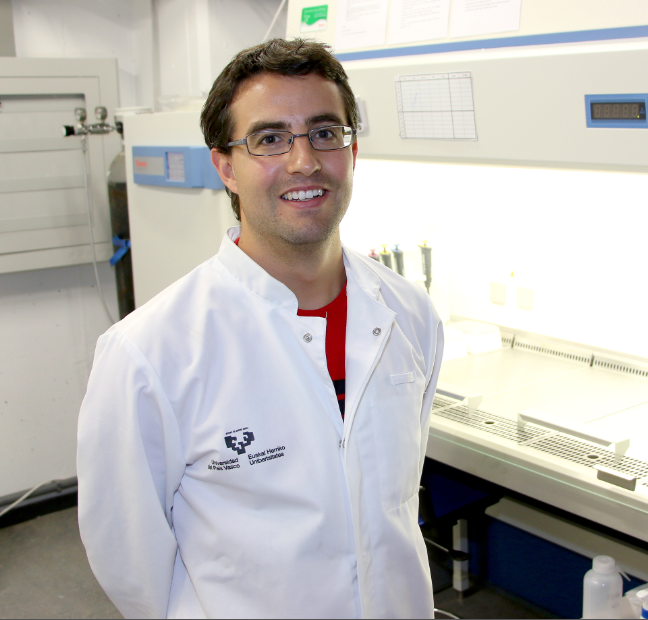
I am currently an Associate Professor at the University of the Basque Country (UPV/EHU) and co-lead the Group of Science and Engineering of Polymeric Biomaterials at POLYMAT. My research focuses on the development of advanced polymer-based therapeutic systems, particularly polymeric capsules, as well as on the design of in vitro models to understand and modulate cell–biomaterial interactions. My work aims to bridge fundamental materials science with biomedical applications, contributing to the development of next-generation therapeutic and regenerative strategies.
Since completing my PhD (2014), I have consolidated an independent research profile with sustained scientific output and increasing international recognition. I have authored more than 60 peer-reviewed publications, accumulating over 2,000 citations and an h-index of 30 (Google Scholar). My research has been published in leading journals in the fields of biomaterials and materials science, reflecting both the quality and impact of my contributions.
I have actively contributed to the attraction of competitive funding, participating in multiple national, regional, and European initiatives. I have led 8 research projects as principal investigator and I am currently involved in two Marie Skłodowska-Curie Doctoral Networks (MSCA-DN), fostering international training and collaboration. In addition, I coordinate an ENLIGHT Thematic Network, strengthening interdisciplinary connections across European institutions.
Beyond research, I am engaged in the supervision of young researchers and in the consolidation of collaborative networks at the international level. I also contribute to the scientific community through peer-review activities and participation in evaluation processes.
Overall, my research is driven by the goal of designing functional polymeric systems with precise biological performance, enabling improved therapeutic outcomes and advancing the understanding of biomaterial–cell interactions.
Engineering biocompatible chitosan hydrogels with polyether-based crosslinkers for biomedical applications.
N. Politakos, C. Busatto, M. Orellano, S. Martin-Colomo, A. Larranaga, D. Estenoz and M. Calderon
Mixed ionic-electronic conducting eutectic soft materials for bioelectronics
M. Firuzeh, E. Giuzio, A. Larranaga and M. Picchio
4D-Printable Poly(Thio)urethane Photoresins With Reactive Oxygen Species Responsiveness and Anti-Inflammatory Functionality
X. Lopez de Pariza, L. Arevalo-Lagos, L. Breloy, O. Varela, A. Larranaga, J. Cadavid-Vargas, O. Garagarza-Goienetxea, M. Moya-Granados, V. Bagnarello, H. Sardon and M. Criado-Gonzalez
Surface functionalization of multilayer nanoparticles with hyaluronic acid or alternative polymers: Effects on cellular uptake and re-epithelialization in a human ex vivo wound model
M. Motta, U. Semenko, U. Goswami, Z. Zhao, F. Rancan, A. Larranaga and M. Calderdon
Manganese Oxide as an Electrochemical Sensor for Carbamazepine and Sulfamethoxazole in Wastewater Samples
P. Mokaba, C. Nepfumbada, B. Mathe, A. Larrañaga, N. Hlongwa and U. Feleni
Nanopatterned bioresorbable elastomeric scaffolds to promote neural, glial, and endothelial differentiation using human embryonic and induced pluripotent stem cells
I. Romayor, S. Martín-Colomo, Y. Polo, C. Bello, R. Basanta-Torres, I. Manero-Roig, B. Pardo-Rodríguez, J. Luzuriaga, F. Unda, J.R. Sarasua, G. Ibarretxe, A. Larrañaga, C. Eguizabal and J. Pineda
Tailoring piezoelectric response in stereocomplexed polylactide systems through nanoparticle incorporation and microstructure control
Raef M., Panfilo A., Larrañaga A., Azkune M., González A., Etxeberria A. and M. Ugartemendia J.
Microglia encapsulation in nanozyme-loaded hydrogels: response to oxidative stress and inflammation
Martín-Colomo S., Ontoria A., Tapeinos C., Beloqui A., Pineda J.R. and Larrañaga A.
Structure-property relationships in minimally processed insect chitin/ carboxymethyl cellulose films
M. Aretxabaleta, P. Yimlamai, A. Larranaga, D. de Aberasturi, B. Tardy, T. Rosenau, M. Beaumont, A. Potthast and E. Lizundia
Compartmentalization of multilayer microreactors using protein-polymer hybrids
I. Alonso-Sampedro, A. Larrañaga and A. Beloqui
Polymer-based nanocarriers to transport therapeutic biomacromolecules across the blood-brain barrier
E. Romero-Ben, U. Goswami, J. Soto-Cruz, A. Mansoori-Kermani, D. Mishra, S. Martin-Saldaña, J. Muñoz-Ugartemendia, A. Sosnik, M. Calderón, A. Beloqui and A. Larrañaga
Structure and nanotoxicity of fungal chitin-glucan nanofibrils with gradient acid and alkaline treatments
J. Cadavid, A. Larrañaga and E. Lizundia
Polypeptide-based multilayer capsules with anti-inflammatory properties: exploring different strategies to incorporate hydrophobic drugs
M. Motta, S. Martin-Saldaña, A. Beloqui, M. Calderón and A. Larrañaga
Immobilization of Enzyme–Polymer Hybrids and Nanozymes Through Electrostatic Interactions: Toward Multicatalytic Microreactors with Controlled Nanoarchitecture
A. Ontoria, I. Alonso-Sampedro, Y. Yan, A. Latif, B. Spencer, A. Larrañaga, A. Beloqui and C. Tapeinos
Elastomeric Protein Bioactive Eutectogels for Topical Drug Delivery
M. Picchio, M. Orellano, M. Motta, C. Huck-Iriart, D. Sánchez-deAlcázar, R. López-Domene, B. Martín-García, A. Larrañaga, A. Beloqui, D. Mecerreyes and M. Calderón
A Single Amino Acid Able to Promote High-Temperature Ring-Opening Polymerization by Dual Activation
E. Gabirondo, K. Swiderek, E. Marin, A. Maiz-Iginitz, A. Larranaga, V. Moliner, A. Etxeberria and H. Sardon
Properties and environmental sustainability of fungal chitin nanofibril reinforced cellulose acetate films and nanofiber mats by solution blow spinning
A. Kramar, J. González-Benito, N. Nikolic, A. Larrañaga and E. Lizundia
Physicochemical Characterization and In Vitro Activity of Poly(e-Caprolactone)/Mycophenolic Acid Amorphous Solid Dispersions
O. Sánchez-Aguinagalde, E. Sanchez-Rexach, Y. Polo, A. Larrañaga, A. Lejardi, E. Meaurio and J.R. Sarasua
Intracranial graft of bioresorbable polymer scaffolds loaded with human Dental Pulp Stem Cells in stab wound murine injury model
I. Manero-Roig, Y. Polo, B. Pardo-Rodríguez, J. Luzuriaga, R. Basanta-Torres, D. Martín-Aragón, I. Romayor, S. Martín-Colomo, J. Márquez, L. Gomez-Santos, F. Lanore, Y. Humeau, G. Ibarretxe, C. Eguizabal, A. Larrañaga and J. Pineda
Polypeptide-based multilayer nanoarchitectures: Controlled assembly on planar and colloidal substrates for biomedical applications
M. Motta, L. Mulko, E. Marin, A. Larrañaga and M. Calderón
Enhanced Piezoelectric Properties of Poly(L-lactide) Nanocomposite Microfiber Scaffolds Due to Polydopamine-Coating of Barium Titanate Nanoparticles
R. Schönlein, X. Larrañaga, A. Panfilo, Y. Li, A. Larrañaga, G. Liu, A.J. Müller, R. Aguirresarobe and J. Ugartemendia
Self-assembled three-dimensional hydrogels based on graphene derivatives and cerium oxide nanoparticles: scaffolds for co-culture of oligodendrocytes and neurons derived from neural stem cells
Y. Polo, J. Luzuriaga, S. Gonzalez de Langarica, B. Pardo-Rodriguez, D. Martinez-Tong, C. Tapeinos, I. Manero-Roig, E. Marin, J. Munoz-Ugartemendia, G. Ciofani, G. Ibarretxe, F. Unda, J.R. Sarasua, J. Pineda and A. Larranaga
Hyaluronic Acid-Based Bioconjugate Systems, Scaffolds, and Their Therapeutic Potential
N. Kotla, I. Mohd Isa, A. Larrañaga, B. Maddiboyina, S. Swamy, G. Sivaraman and P. Vemula
Thermoplastic elastomers based on lactide and caprolactone: The influence of chain microstructure on surface topography and subsequent interaction with cells
C. Bello-Álvarez, B. Atxa Ainz, J. Ugartemendia, L. Sebastián, A. Etxeberria, J.R. Sarasua, E. Zuza and A. Larrañaga
The role of Eudragit® as a component of hydrogel formulations for medical devices
D. Esporrín-Ubieto, A. Sonzogni, M. Fernández, A. Acera, E. Matxinandiarena, J. Cadavid-Vargas, I. Calafel, R. Schmarsow, A.J. Müller, A. Larrañaga and M. Calderón
Cytotoxicity and Inflammatory Effects of Chitin Nanofibrils Isolated from Fungi
A. Larrañaga, C. Bello-Álvarez and E. Lizundia
Exploiting the layer-by-layer nanoarchitectonics for the fabrication of polymer capsules: A toolbox to provide multifunctional properties to target complex pathologies
E. Marin, C. Tapeinos, J.R. Sarasua and A. Larrañaga
In vitro preparation of human Dental Pulp Stem Cell grafts with biodegradable polymer scaffolds for nerve tissue engineering
J. Pineda, Y. Polo, B. Pardo-Rodríguez, J. Luzuriaga, V. Uribe-Etxebarria, P. García-Gallastegui, J.R. Sarasua, A. Larrañaga and G. Ibarretxe
Innovative nanotechnology tools for the functional control and tracking of human stem cells
A. Marino, M. Battaglini, C. Tapeinos, A. Larrañaga and G. Ciofani
Lactide and Ethylene Brassylate-Based Thermoplastic Elastomers and Their Nanocomposites with Carbon Nanotubes: Synthesis, Mechanical Properties and Interaction with Astrocytes
C. Bello-Álvarez, A. Etxeberria, Y. Polo, J.R. Sarasua, E. Zuza and A. Larrañaga
Crystallization-Induced Gelling as a Method to 4D Print Low-Water-Content Non-isocyanate Polyurethane Hydrogels
N. Fanjul-Mosteirin, R. Aguirresarobe, N. Sadaba, A. Larranaga, E. Marin, J. Martin, N. Ramos-Gomez, M. Arno, H. Sardon and A. Dove
Nanostructured scaffolds based on bioresorbable polymers and graphene oxide induce the aligned migration and accelerate the neuronal differentiation of neural stem cells
Y. Polo, J. Luzuriaga, J. Iturri, I. Irastorza, J. Toca-Herrera, G. Ibarretxe, F. Unda, J.R. Sarasua, J. Pineda and A. Larrañaga
Advances and perspectives in dental pulp stem cell based neuroregeneration therapies
J. Luzuriaga, Y. Polo, O. Pastor-alonso, B. Pardo-rodríguez, A. Larrañaga, F. Unda, J.R. Sarasua, J. Pineda and G. Ibarretxe
An engineered coccolith-based hybrid that transforms light into swarming motion
M. Lomora, A. Larrañaga, C. Rodriguez-Emmenegger, B. Rodriguez, I. Dinu, J.R. Sarasua and A. Pandit
Smart Layer-by-Layer Polymeric Microreactors: PH-Triggered Drug Release and Attenuation of Cellular Oxidative Stress as Prospective Combination Therapy
E. Marin, N. Tiwari, M. Calderón, J.R. Sarasua and A. Larrañaga
A Self-Powered Piezo-Bioelectric Device Regulates Tendon Repair-Associated Signaling Pathways through Modulation of Mechanosensitive Ion Channels
M. Fernandez-Yague, A. Trotier, S. Demir, S. Abbah, A. Larranaga, A. Thirumaran, A. Stapleton, S. Tofail, M. Palma, M. Kilcoyne, A. Pandit and M. Biggs
Benefits of Polydopamine as Particle/Matrix Interface in Polylactide/PD-BaSO(4)Scaffolds
N. Sadaba, A. Larranaga, G. Orpella-Aceret, A. Bettencourt, V. Martin, M. Biggs, I. Ribeiro, J. Ugartemendia, J.R. Sarasua and E. Zuza
Advanced Functional Materials and Cell-Based Therapies for the Treatment of Ischemic Stroke and Postischemic Stroke Effects
C. Tapeinos, A. Larranaga, F. Tomatis, J. Bizeau, A. Marino, M. Battaglini, A. Pandit and G. Ciofani
Homotypic targeting and drug delivery in glioblastoma cells through cell membrane-coated boron nitride nanotubes
D. De Pasquale, A. Marino, C. Tapeinos, C. Pucci, S. Rocchiccioli, E. Michelucci, F. Finamore, L. McDonnell, A. Scarpellini, S. Lauciello, M. Prato, A. Larrañaga, F. Drago and G. Ciofani
Encapsulation of manganese dioxide nanoparticles into layer-by-layer polymer capsules for the fabrication of antioxidant microreactors
E. Marin, C. Tapeinos, S. Lauciello, G. Ciofani, J.R. Sarasua and A. Larrañaga
A review on the thermomechanical properties and biodegradation behaviour of polyesters
A. Larranaga and E. Lizundia
Cell Membrane-Coated Magnetic Nanocubes with a Homotypic Targeting Ability Increase Intracellular Temperature due to ROS Scavenging and Act as a Versatile Theranostic System for Glioblastoma Multiforme
C. Tapeinos, F. Tomatis, M. Battaglini, A. Larranaga, A. Marino, I. Telleria, M. Angelakeris, D. Debellis, F. Drago, F. Brero, P. Arosio, A. Lascialfari, A. Petretto, E. Sinibaldi and G. Ciofani
Functionalised collagen spheres reduce H2O2 mediated apoptosis by scavenging overexpressed ROS
C. Tapeinos, A. Larranaga, J.R. Sarasua and A. Pandit
Understanding the toughness mechanism prompted by submicron rigid particles in polylactide/barium sulfate composites
N. Sadaba, R. Martini, F. Barthelat, I. Martinez de Arenaza, A. Larranaga, J.R. Sarasua and E. Zuza
Antioxidant functionalized polymer capsules to prevent oxidative stress
A. Larranaga, I. Isa, V. Patil, S. Thamboo, M. Lomora, M. Fernandez-Yague, J.R. Sarasua, C. Palivan and A. Pandit
Tougher biodegradable polylactide system for bone fracture fixations: Miscibility study, phase morphology and mechanical properties
J. Ugartemendia, A. Larranaga, H. Amestoy, A. Etxeberria and J.R. Sarasua
Tough polylactide blend system for osteosynthesis procedures
J. Muñoz, E. Aldalur, E. Sanchez-Rexach, I. Revilla, A. Larrañaga and J.R. Sarasua
Biochemical aspects of microbial product synthesis: A relook
G. Gallastegui, A. Larrañaga, A. Ramirez and T. Pham
Synthesis and characterization of hyaluronic acid coated manganese dioxide microparticles that act as ROS scavengers
J. Bizeau, C. Tapeinos, C. Marella, A. Larranaga and A. Pandit
Polymer capsules as micro-/nanoreactors for therapeutic applications: Current strategies to control membrane permeability
A. Larranaga, M. Lomora, J.R. Sarasua, C. Palivan and A. Pandit
Poly(alpha-hydroxy Acids)-Based Cell Microcarriers
A. Larranaga and J.R. Sarasua
Effects of isothermal crystallization on the mechanical properties of a elastomeric medium chain length polyhydroxyalkanoate
A. Larranaga, F. Pomparion, N. Gruffat, T. Palomares, A. Alonso-Varona, A. Larranaga Varga, M. Fernandez-Yague, M. Biggs and J.R. Sarasua
Polyhydroxyalkanoate/carbon nanotube nanocomposites: flexible electrically conducting elastomers for neural applications
C. Vallejo-Giraldo, E. Pugliese, A. Larranaga, M. Fernandez-Yague, J. Britton, A. Trotier, G. Tadayyon, A. Kelly, I. Rago, J.R. Sarasua, E. Dowd, L. Quinlan, A. Pandit and M. Biggs
Ethylene brassylate-co-delta-hexalactone biobased polymers for application in the medical field: synthesis, characterization and cell culture studies
J. Fernandez, A. Larranaga, A. Etxeberria and J.R. Sarasua
Synthesis and characterization of u-pentadecalactone-co-epsilon-decalactone copolymers: Evaluation of thermal, mechanical and biodegradation properties
J. FERNÁNDEZ, A. Etxeberria, A. Larrañaga Varga and J.R. Sarasua
Effect of bioactive glass particles on osteogenic differentiation of adipose-derived mesenchymal stem cells seeded on lactide and caprolactone based scaffolds
Larrañaga A, Alonso-Varona A, Palomares T, Rubio-Azpeitia E, Aldazabal P, Martin FJ and J.R. Sarasua
High toughness biodegradable radiopaque composites based on polylactide and barium sulphate
I. Martinez de Arenaza, N. Sadaba, A. Larrañaga, E. Zuza and J.R. Sarasua
Effects of Polydopamine Functionalization on Boron Nitride Nanotube Dispersion and Cytocompatibility
Fernandez-Yague MA, Larrañaga A, Gladkovskaya O, Stanley A, Tadayyon G, Guo Y, J.R. Sarasua, Tofail SA, Zeugolis DI, Pandit A and Biggs MJ
An academic, clinical and industrial update on electrospun, additive manufactured and imprinted medical devices
Ryan CN, Fuller KP, Larrañaga A, Biggs M, Bayon Y, J.R. Sarasua, Pandit A and Zeugolis DI
Coating of bioactive glass particles with mussel-inspired polydopamine as a strategy to improve the thermal stability of poly(L-lactide)/bioactive glass composites
A. Larranaga, D. Ramos, H. Amestoy, E. Zuza and J.R. Sarasua
Hydrolytic degradation and bioactivity of lactide and caprolactone based sponge-like scaffolds loaded with bioactive glass particles
A. Larranaga, P. Aldazabal, F. Martin and J.R. Sarasua
Crystallization and its effect on the mechanical properties of a medium chain length polyhydroxyalkanoate
A. Larranaga, J. Fernandez, A. Vega, A. Etxeberria, C. Ronchel, J. Adrio and J.R. Sarasua
Supramolecular evolution over an initial period of biodegradation of lactide and caprolactone based medical (co)polyesters
J. Ugartemendia, A. Larranaga, H. Amestoy and J.R. Sarasua
A new generation of poly(lactide/epsilon-caprolactone) polymeric biomaterials for application in the medical field
J. Fernandez, A. Larranaga, A. Etxeberria, W. Wang and J.R. Sarasua
A study of the mechanical properties and cytocompatibility of lactide and caprolactone based scaffolds filled with inorganic bioactive particles
A. Larranaga, E. Diamanti, E. Rubio, T. Palomares, A. Alonso-Varona, P. Aldazabal, F. Martin and J.R. Sarasua
Tensile behavior and dynamic mechanical analysis of novel poly(lactide/delta-valerolactone) statistical copolymers
J. Fernandez, A. Larranaga, A. Etxeberria and J.R. Sarasua
Grafting of a model protein on lactide and caprolactone based biodegradable films for biomedical applications.
Larrañaga A, Guay-Bégin AA, Chevallier P, Sabbatier G, Fernández J, Laroche G and J.R. Sarasua
Improvement of thermal stability and mechanical properties of medical polyester composites by plasma surface modification of the bioactive glass particles
A. Larranaga, S. Petisco and J.R. Sarasua
Effect of bioactive glass particles on the thermal degradation behaviour of medical polyesters
A. Larranaga and J.R. Sarasua
EFFECT OF PROTEIN GRAFTING ON THE HYDROLYTIC DEGRADATION OF LACTIDE AND CAPROLACTONE BASED BIODEGRADABLE ELASTOMERIC TERPOLYMER.
A. LARRAÑAGA ESPARTERO, A.A. Guay-Begin, P. Chevallier, G. Sabbatier, J. FERNÁNDEZ, G. Laroche and J.R. Sarasua
EFFECTS OF THERMO-MECHANICAL TREATMENTS ON MECHANICAL PROPERTIES OF LACTIDE
S. PETISCO, A. LARRAÑAGA ESPARTERO, C. GARCIA PARIENTE and J.R. Sarasua
PHASE-STRUCTURAL EVOLUTION IN POLYLACTIDES DUTRING AN INITIAL 7 DAY DEGRADATION PERIOD IN PBS
Amestoy H, A. LARRAÑAGA ESPARTERO, Ugartemendia JM and J.R. Sarasua

