
Low-temperature depolymerization of PET
Polímeros y sostenibilidad
Background
Poly(ethylene terephthalate) (PET) is one of the most widely used plastics globally, but its durability makes it difficult to recycle efficiently. Conventional recycling methods require high temperatures, strong solvents, or complex separation steps, which limit their industrial viability. Developing low-temperature catalytic routes for PET depolymerization is essential to achieve more sustainable and energy-efficient recycling.
Invention
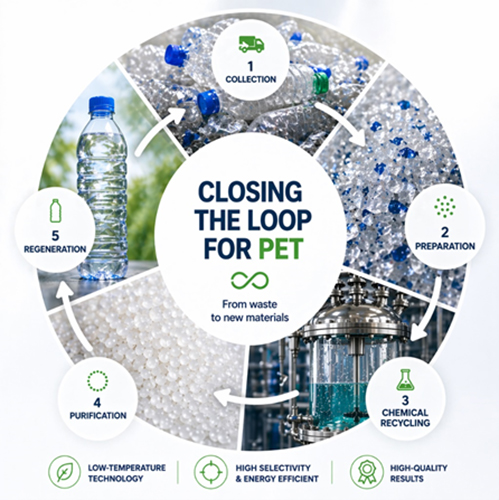
This invention introduces a mild, organocatalytic process for the chemical recycling of PET using a thermally stable protic ionic salt catalyst.
The catalyst promotes glycolysis of PET at low temperatures, operating under solvent-free conditions and enabling high selectivity and efficiency even in the presence of other polymers such as polycarbonate (BPA-PC).
The process yields bis(2-hydroxyethyl) terephthalate (BHET) with high purity, allowing closed-loop recycling and chemical upcycling into new value-added materials.
This approach overcomes the limitations of traditional methods, providing a scalable, low-energy alternative compatible with mixed or contaminated PET waste.
Potential Applications
- Sustainable PET recycling and upcycling into new polymers.
- Recovery of monomers from packaging and textile waste.
- Integration into mixed-plastic recycling plants.
- Development of circular polymer manufacturing platforms.
Key Benefits
- Low-temperature, solvent-free chemical depolymerization of PET.
- High selectivity and conversion using a recyclable, non-metallic catalyst.
- Enables circular recycling and recovery of pure BHET monomer.
- Tolerant to polymer blends and additives.
- Scalable and energy-efficient process suitable for industrial implementation.
IPR Status
- Patent number: EP4353774B1
- Priority date: 10/10/2022
Related Publications
Jehanno, J. Demarteau, D. Mantione, M. C. Arno, F. Ruipérez, J. L. Hedrick, A. P. Dove, H. Sardon, Angew. Chem. Int. Ed., 2021, 60, 6710–6717. https://doi.org/10.1002/anie.202014860

