
Rajat Rai
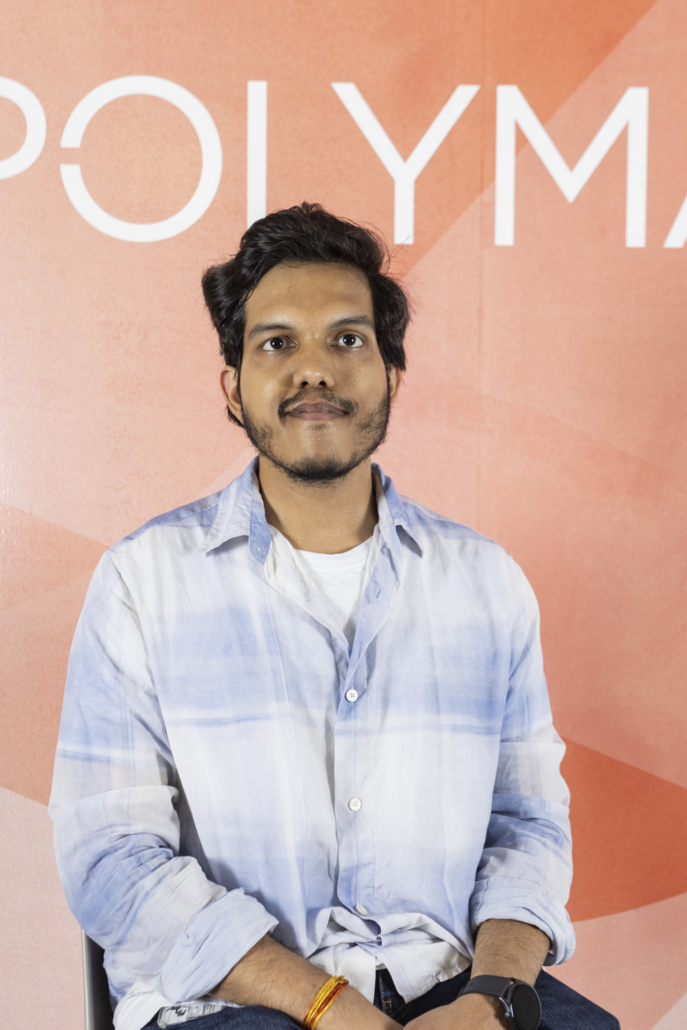
Rajat Rai received his bachelor’s degree in June 2019 in Chemistry from Zakir Husain Delhi College, University of Delhi, India.
In June 2022 he successfully defended his master’s thesis and received his master’s degree in Chemistry from the Indian Institute of Technology (IIT) Bhubaneshwar, India.
He joined POLYMAT for his Ph.D. in October 2022, under the supervision of Dr. Miryam Criado González and Dr. Daniele Mantione.
Rajat Rai did an internship in May-June 2019, on Nitration of aromatic compounds during which he learned how to do regioselective nitration of aromatic compounds using Urea Nitrate as a nitrating agent and monitor a reaction.
His master’s thesis was focused on Polymer Catalysed α-amination of Carbonyl Compounds. He did 𝛼-amination of different types of carbonyl compounds (including aliphatic aldehydes, cyclic-β-keto esters, and functionalized oxindoles) with different aminating agents through novel chiral in-house prepared polymeric organocatalysts. He tried to find the best conditions for all the reactions and got efficient conversions further he purified, characterized, and isolated those products properly.
His Ph.D research is focused on the synthesis and characterization of PEDOT/biopolymer dispersions for (bio)electronics including 3D printing methods.
Publicaciones
Improvement of electronic structure, optical properties, and crystalline quality of FAPbI3 perovskite thin films by poly(ionic liquid) additives based on polymerized TFSI ion
V. Rajic, B. Ramadani, N. Latas, M. Milovic, R. Rai, D. Mantione and M. Ivanovic
Key Trends and Insights in Smart Polymeric Skin Wearable Patches
S. Peñas-Núñez, R. Rai and M. Criado-Gonzalez
Screen-printing Resistive Temperature Sensor development with sustainable carbon pastes
L. Sanchez-Duenas, C. Monteserin, E. Gomez, M. Blanco, M. Larranaga, E. Aranzabe, M. Criado-Gonzalez, R. Rai and J. Vilas-Vilela
Biohybrid Energy Storage Circuits Based on Electronically Functionalized Plant Roots
D. Parker, A. Dar, A. Armada-Moreira, I. Bernacka Wojcik, R. Rai, D. Mantione and E. Stavrinidou

