
Malavika Raj
PhD student
Machine Learning for Polymer Development
Polymerization engineering and simulation


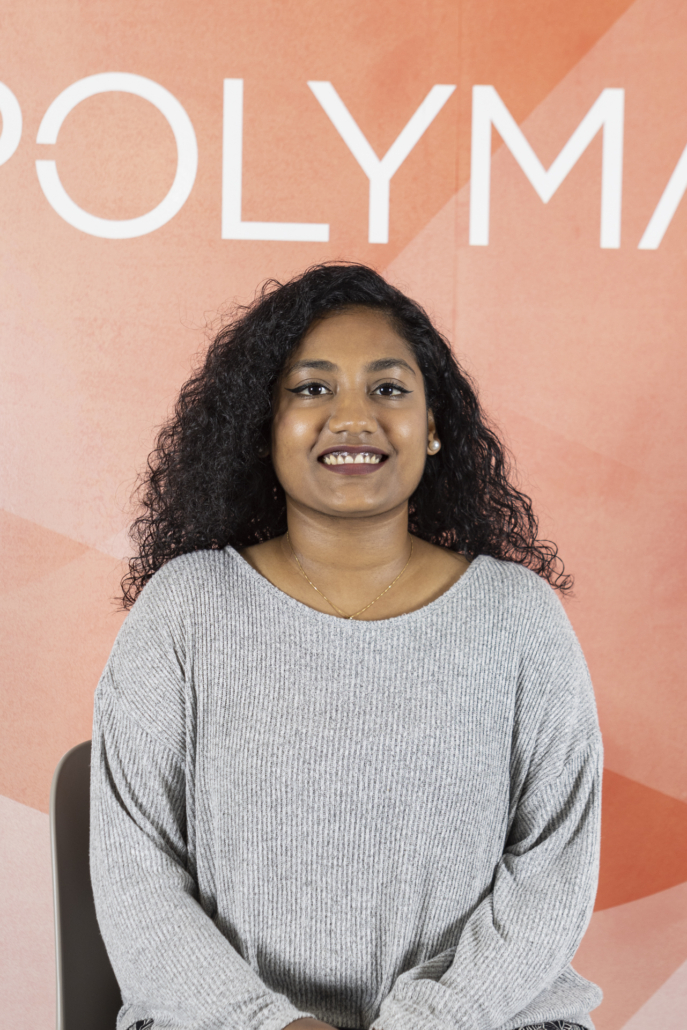
Malavika earned her Master's degree in Chemistry from Amrita University, India, graduating with first rank in the Five-Year Integrated Master's Programme in 2020. During her Master's studies, she completed her research project at CSIR–National Chemical Laboratory (India), where she developed polyethersulfone-based hollow-fibre membranes for gas separation applications. She also carried out a minor research project at Amrita University, synthesizing and characterizing copper pyromellitate metal–organic frameworks (MOFs) and investigating their reactions with organic bases.
In 2018, she was awarded the prestigious IASc–INSA–NASI Summer Research Fellowship and conducted research at CSIR–National Institute for Interdisciplinary Science and Technology (India). Her work focused on stimuli-responsive self-assembly, during which she designed and synthesized a terpyridine-appended tetraphenylethylene derivative.
From 2020 to 2022, she worked as a Science Editor (Chemistry) at Continual Engine (India). In this role, she edited AI-generated alt text to improve digital accessibility and contributed to projects for leading educational publishers, including Macmillan and Pearson.
In June 2023, she joined POLYMAT to pursue her PhD under the supervision of Prof. Nicholas Ballard. Her doctoral research is supported by the Marie Skłodowska-Curie Actions (MSCA) Doctoral Network as part of the European project CINEMA (Grant Agreement No. 101072732), which aims to leverage machine learning for the design and control of polymerization processes and polymer products. Her research addresses one of the key challenges in pressure-sensitive adhesives (PSAs): the complex relationship between formulation and performance, which makes it difficult to predict their adhesive properties. By combining first-principles modeling with machine learning, she is developing physics-informed predictive models to bridge this gap and accelerate the design of PSAs.
In April 2026, she completed a three-month industrial internship at Arkema's Boretto site in Italy, where she developed machine learning models for pressure-sensitive adhesives using industrial datasets.
No hay publicaciones disponibles en este momento.

