
María Paulis
Research Staff
Coordinator
High Performance Polymers
Polymerization engineering and simulation


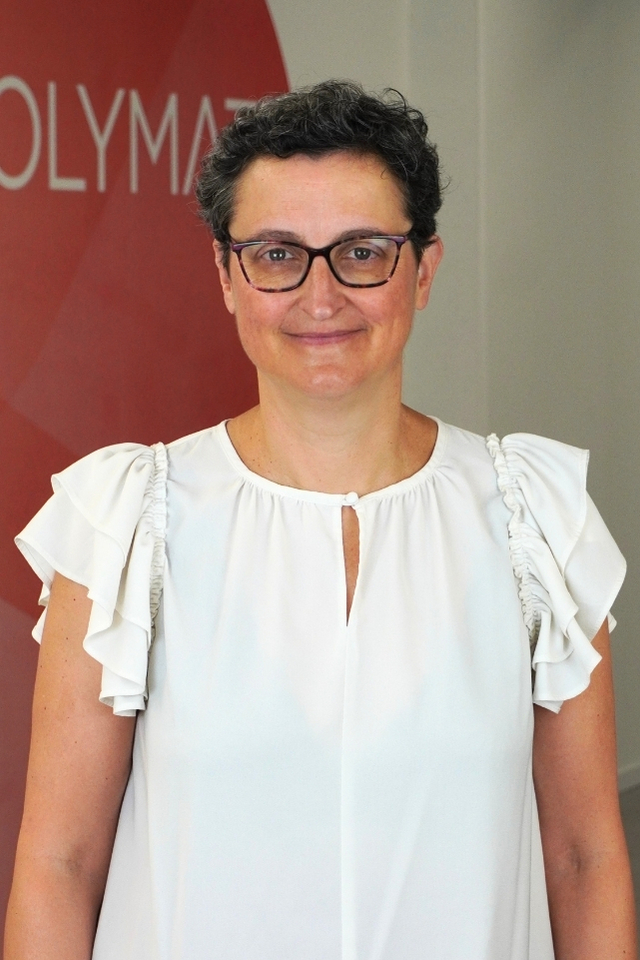
María Paulis Lumbreras earned a degree in Chemistry from the Faculty of Chemistry at the University of the Basque Country (Extraordinary Award for Academic Excellence) and a BSc in Applied Chemistry from the University of Strathclyde (Glasgow, UK), in 1995. She completed her PhD in heterogeneous catalysis for the removal of Volatile Organic Compounds under the supervision of Prof. Mario Montes at the Faculty of Chemistry of EHU. Following a period of postdoctoral research focused on the detection of N-nitrosamines in rubber manufacturing industries, she obtained a position as Associate Professor at the EHU in 2002, where her research interests shifted toward polymerization in dispersed media.
She has held several academic leadership positions within the Faculty of Chemistry of EHU, including Degree Coordinator (2012–2016) and Vice-Dean for International Relations (2016–2020). Since 2020, she has served as Director of the POLYMAT University Institute for Polymer Materials, and since 2024 she is Full Professor of Chemical Engineering at EHU.
She is currently the Principal Investigator of the Industrial Liaison Program on Polymerization in Dispersed Media. This program was launched in 2003 under the leadership of Professor José M. Asua and, throughout its history, has involved more than 20 international companies from the dispersed-polymer industry, which have supported the program through the funding of doctoral theses. In addition, she has led several bilateral research projects in collaboration with national and international chemical companies.
She has published more than 100 papers in international scientific journals, holds four patents, and has supervised 17 doctoral dissertations. Her research focuses on polymerization in dispersed media; the study and optimization of film formation processes from polymer dispersions; the incorporation of bio-based and/or biodegradable monomers; and the optimization of end-use properties such as anticorrosion performance and adhesive properties, while also promoting the sustainability of production processes.
Influence of Coalescing Aids on Hardness Development and Water Resistance of Alkali-Soluble Resin-Stabilized Latex Films
W. Tangsongcharoen and M. Paulis
Mitigating Magnesium Reactivity in CeO2-Containing Waterborne Coatings Through ZrCC and LDH Surface Pre-Treatments
J. Gomez-Granados, M. Paulis, M. Mohedano, R. Arrabal, J.R. Leiza and J. Vega
Waterborne Biodegradable Polyesters Based on Thiol–Ene Chemistry for Paper Coating Applications
M. Naderi, S. Beldarrain, M. Paulis and J.R. Leiza
Optofluidic Force Induction for Online Monitoring of Particle Size Distributions in Emulsion Polymerization Reactions
U. Aspiazu, M. Simic, M. Schnur, U. Hohenester, C. Hill, D. Auer, M. Paulis and J.R. Leiza
Direct-to-metal binders for waterborne anticorrosive steel coatings: Epoxy/styrene-acrylic blends and hybrids
A. del Castillo, M. Paulis and E. Gonzalez
Sensitivity of the particle size determined inline by Photon Density Wave Spectroscopy with respect to sample properties and measurement settings during emulsion copolymerization reactions
U. Aspiazu, S. Zimmermann, M. Münzberg, J.R. Leiza and M. Paulis
Corrosion Protection of Mild Steel in Acidic Environments by Cetrimonium Cinnamates in Solution and Added to a Low Volatile Organic Compound Coating
D. Quites Rodrigues, M. Ghorbani, J. Soto Puelles, S. Crawford, M. Paulis, M. Forsyth and A. Somers
Multilayer dual-porosity 3D printed scaffolds to recreate the anisotropic microenvironment of the hyaline cartilage
S. Ramos-Díez, L. Diaz-Gomez, M. Paulis and S. Camarero-Espinosa
Combined effect of acetoacetoxy - Amine interparticle crosslinking and different TG polymer phases to obtain high performance waterborne wood coatings
S. Tariq, N. Veling and M. Paulis
Photon Density Wave spectroscopy to monitor the particle size in seeded semibatch emulsion copolymerization reactions
U. Aspiazu, M. Paulis and J.R. Leiza
Effect of plasticizer release on the final properties of blend, hybrid and block copolymer latex films containing hard and soft phases
W. Tangsongcharoen and M. Paulis
Real-Time Monitoring of Particle Size in Emulsion Polymerization: Simultaneous Turbidity and Photon Density Wave Spectroscopy
U. Aspiazu, S. Gómez, M. Paulis and J.R. Leiza
Crosslinking versus interdiffusion in two pot one pack acetoacetoxy-amine based binder system
S. Tariq, L. Irusta, M. Fernández and M. Paulis
Fabrication of Multifunctional Composite Nanofibers by Green Electrospinning
E. Gonzalez, A. Barquero, M. Paulis and J.R. Leiza
Polymer Colloids: Current Challenges, Emerging Applications, and New Developments
M. Aguirre, N. Ballard, E. Gonzalez, S. Hamzehlou, H. Sardon, M. Calderon, M. Paulis, R. Tomovska, D. Dupin, R. Bean, T. Long, J.R. Leiza and J. Asua
Synthesis of Waterborne Anticorrosive Coatings Based on The Incorporation of Phosphate Groups to Polyurethane-Acrylate Hybrids
A. Barquero, O. Llorente, D. Minudri, M. Paulis and J.R. Leiza
Development of waterborne anticorrosive coatings by the incorporation of coumarate based corrosion inhibitors and phosphate functionalization
D. Quites, A. Somers, M. Forsyth and M. Paulis
Wavelength exponent based calibration for turbidity spectroscopy: Monitoring the particle size during emulsion polymerization reactions
U. Aspiazu, S. Hamzehlou, N. Palombo Blascetta, M. Paulis and J.R. Leiza
Challenges to incorporate high contents of bio-based isobornyl methacrylate (IBOMA) into waterborne coatings
O. Llorente, A. Barquero, M. Paulis and J.R. Leiza
Kinetic study of crosslinking between acetoacetoxy and hexamethylene diamine functionalized waterborne latexes in two-pack systems
S. Tariq, L. Irusta, M. Fernández and M. Paulis
Taking Advantage of Phosphate Functionalized Waterborne Acrylic Binders to Get Rid of Inhibitors in Direct-to-Metal Paints
Chimenti S., Cerra M., Zanetta T., J.R. Leiza and Paulis M.
Strategies to incorporate a fluorinated acrylate monomer into polymer particles: from particle morphology to film morphology and anticorrosion properties
S. Chimenti, J. Vega, M. Paulis and J.R. Leiza
Reducing the amount of coalescing aid in high performance waterborne polymeric coatings
S. Dron, S. Bohorquez, D. Mestach and M. Paulis
Incorporation of a Coumarate Based Corrosion Inhibitor in Waterborne Polymeric Binders for Corrosion Protection Applications
D. Quites, J.R. Leiza, D. Mantione, A. Somers, M. Forsyth and M. Paulis
Cross-Sectional Chemical Nanoimaging of Composite Polymer Nanoparticles by Infrared Nanospectroscopy
M. Goikoetxea, I. Amenabar, S. Chimenti, M. Paulis, J.R. Leiza and R. Hillenbrand
Green electrospinning of polymer latexes: A systematic study of the effect of latex properties on fiber morphology
E. Gonzalez, A. Barquero, B. Muñoz-sanchez, M. Paulis and J.R. Leiza
Assessing the effect of CeO2 nanoparticles as corrosion inhibitor in hybrid biobased waterborne acrylic direct to metal coating binders
E. González, R. Stuhr, J. Vega, E. García-lecina, H. Grande, J.R. Leiza and M. Paulis
Einzelschicht mit vielfältigen Eigenschaften
S. Chimenti, M. Paulis, J.R. Leiza, J. Vega, E. Garcia-Lecina and H. Grande
Tracking Hydroplasticization by DSC: Movement of Water Domains Bound to Poly(Meth)Acrylates during Latex Film Formation
S. Dron and M. Paulis
Design of Waterborne Asymmetric Block Copolymers as Thermoresponsive Materials
G. Petreska, C. van Sluijs, C. Auschra and M. Paulis
Impact of the in-situ phosphatization on the corrosion resistance of steel coated with fluorinated waterborne binders assessed by SKP and EIS
J. Vega, S. Chimenti, E. García-Lecina, H. Grande, M. Paulis and J.R. Leiza
Combined Effect of Crystalline Nanodomains and in Situ `Phosphatization on the Anticorrosion Properties of Waterborne Composite Latex Films
S. Chimenti, J. Manuel Vega, E. Garcia Lecina, H. Jurgen Grande, M. Paulis and J.R. Leiza
Isolation of the interaction between CaCO3 filler and acrylic binder. Part I: Effect of the surfactant and functional monomer type
V. Alvarez, N. Williams and M. Paulis
In-situ phosphatization and enhanced corrosion properties of films made of phosphate functionalized nanoparticles
S. Chimenti, J. Manuel Vega, E. Garcia-Lecina, H. Grande, M. Paulis and J.R. Leiza
Isolation of the interaction between CaCO3 filler and acrylic binder. Part II: Effect of the amount and type of functional monomer
V. Alvarez, N. Williams and M. Paulis
Mechanical and Morphological Properties of Waterborne ABA Hard-Soft-Hard Block Copolymers Synthesized by Means of RAFT Miniemulsion Polymerization
G. Petreska, A. Arbe, C. Auschra and M. Paulis
Incorporation of Very Insoluble Monomers in Waterborne Coatings
F. Boscan, M. Meeuwisse, D. Mestach, M. Paulis, Maria J. BARANDIARAN and S. Bohorquez
Confinement driven crystallization of ABA crystalline-soft-crystalline block copolymers synthesized via RAFT mediated miniemulsion polymerization
G. Petreska, C. Auschra and M. Paulis
PS/PMMA-CdSe/ZnS Quantum Dots Hybrid Nanofibers for VOCs Sensors
A. De San Luis, Z. Aguirreurreta, L. Pardo, A. Perez-Marquez, J. Maudes, N. Murillo, M. Paulis and J.R. Leiza
From miniemulsion to nanoemulsion polymerization of superhydrophobic monomers through low energy phase inversion temperature
F. Boscan, Maria J. BARANDIARAN and M. Paulis
Co-encapsulation of CdSe/ZnS and CeO2 nanoparticles in waterborne polymer dispersions: enhancement of fluorescence emission under sunlight
A. Luis, M. Paulis and J.R. Leiza
Effect of acrylic binder type and calcium carbonate filler amount on the properties of paint-like blends
V. Alvarez and M. Paulis
Towards the production of high performance lauryl methacrylate based polymers through emulsion polymerization
F. Boscan, M. Paulis and Maria J. BARANDIARAN
Accelerated ageing of hybrid acrylic waterborne coatings containing metal oxide nanoparticles: Effect on the microstructure
M. Aguirre, M. Goikoetxea, L. Alberto Otero, M. Paulis and J.R. Leiza
Effective incorporation of ZnO nanoparticles by miniemulsion polymerization in waterborne binders for steel corrosion protection
S. Chimenti, J. Manuel Vega, M. Aguirre, E. Garcia-Lecina, J. Antonio Diez, H. Grande, M. Paulis and J.R. Leiza
Toward the minimization of fluorescence loss in hybrid cross-linked core-shell PS/QD/PMMA nanoparticles: Effect of the shell thickness
A. De San Luis, A. Bonnefond, M. Barrado, T. Guraya, M. Iturrondobeitia, A. Okariz, M. Paulis and J.R. Leiza
Magnetic Poly(Ionic Liquid) Microcapsules for Oil Capture and Recovery
A. Fernandes, M. Paulis, J. Yuan and D. Mecerreyes
Knowledge-Based Production of Waterborne Hybrid Polymer Materials
M. PAULIS and J. Asua
Process-Guided Product Design of Hybrid Polymer Materials
M. PAULIS and J. Asua
Preparation of poly(ionic liquid) nanoparticles and their novel application as flocculants for water purification
M. Isik, A. Fernandes, K. Vijayakrishna, M. Paulis and D. Mecerreyes
Isolation of the effect of the hairy layer length on the mechanical properties of waterborne coatings
E. Gonzalez, Maria J. BARANDIARAN and M. Paulis
Dielectric relaxations of Acrylic-Polyurethane hybrid materials
G. Martinez-Rugerio, A. Alegria, V. Daniloska, R. Tomovska, M. Paulis and J. Colmenero
Particle nucleation and growth in seeded semibatch miniemulsion polymerization of hybrid CeO2/acrylic latexes (vol 55, pg 752, 2014)
M. Aguirre, M. Paulis and J.R. Leiza
Effect of alkali-soluble resin emulsifiers on coalescence and interdiffusion between latex polymer particles
E. Gonzalez, C. Tollan, A. Chuvilin, M. Paulis and Maria J. BARANDIARAN
Film forming hybrid acrylic/ZnO latexes with excellent UV absorption capacity
M. Aguirre, M. Barrado, M. Iturrondobeitia, A. Okariz, T. Guraya, M. Paulis and J.R. Leiza
Evolution of Particle Morphology During the Synthesis of Hybrid Acrylic/CeO2 Nanocomposites by Miniemulsion Polymerization
M. Aguirre, M. Paulis, M. Barrado, M. Iturrondobeitia, A. Okariz, T. Guraya, J. Ibarretxe and J.R. Leiza
From Polymer Latexes to Multifunctional Liquid Marbles
Fernandes AM, Mantione D, Gracia R, J.R. Leiza, Paulis M and Mecerreyes D
Crosslinked reduced graphene oxide/polymer composites via in situ synthesis by semicontinuous emulsion polymerization
D. Spasevska, G. Leal, M. Fernandez, J. Gilev, M. Paulis and R. Tomovska
Polimero akriliko/CeO2 estaldura hibridoen sintesia egurraren iraunkortasuna luzatzeko
M. AGUIRRE ARRESE, M. Paulis and J.R. Leiza
(Cryo)-TEM Assessment of Droplet Nucleation Efficiency in Hybrid Acrylic/CeO2 Semibatch Miniemulsion Polymerization
M. Aguirre, M. Barrado, M. Paulis and J.R. Leiza
Effect of controlled length acrylic acid-based electrosteric stabilizers on latex film properties
E. Gonzalez, M. Paulis and Maria J. BARANDIARAN
Mechanistic investigation of the simultaneous addition and free-radical polymerization in batch miniemulsion droplets: Monte Carlo simulation versus experimental data in polyurethane/acrylic systems
S. Hamzehlou, N. Ballard, P. Carretero, M. Paulis, J. Asua, Y. Reyes and J.R. Leiza
Simple route to prepare stable liquid marbles using poly(ionic liquid)s
A. Fernandes, R. Gracia, G. Leal, M. Paulis and D. Mecerreyes
The effect of the crosslinking agent on the performance of propranolol imprinted polymers
I. Iturralde, M. Paulis and J.R. Leiza
High-Performance Adhesives Resulting from Spontaneous Formation of Nanogels within Miniemulsion Particles
V. Daniloska, P. Carretero, R. Tomovska, M. Paulis and J. Asua
Particle nucleation and growth in seeded semibatch miniemulsion polymerization of hybrid CeO2/acrylic latexes
M. Aguirre, M. Paulis and J.R. Leiza
Radical initiator modified cerium oxide nanoparticles for polymer encapsulation via grafting from the surface
E. Salazar-Sandoval, M. Aguirre, M. Paulis, J.R. Leiza, M. Johansson and A. Ahniyaz
Hybrid acrylic/CeO2 nanocomposites using hydrophilic, spherical and high aspect ratio CeO2 nanoparticles
M. Aguirre, E. Salazar-Sandoval, M. Johansson, A. Ahniyaz, M. Paulis and J.R. Leiza
Beneficial in-situ incorporation of nanoclay to waterborne PVAc/PVOH dispersion adhesives for wood applications
P. Peruzzo, A. Bonnefond, Y. Reyes, M. Fernandez, J. Fare, E. Ronne, M. Paulis and J.R. Leiza
Encapsulation with Miniemulsion Polymerization
M. PAULIS and J.R. Leiza
UV absortzio propietateak dituzten estaldura gardenak sortzeko akrilato/CeO2 nanokonposatu ur-dispertsioen sintesia
M. AGUIRRE ARRESE and M. Paulis
Effect of the Incorporation of Modified Silicas on the Final Properties of Wood Adhesives
A. Bonnefond, Y. Reyes, P. Peruzzo, E. Ronne, J. Fare, M. Paulis and J.R. Leiza
High-Solids-Content Hybrid Acrylic/CeO2 Latexes with Encapsulated Morphology Assessed by 3D-TEM
M. Aguirre, M. Paulis, J.R. Leiza, T. Guraya, M. Iturrondobeitia, A. Okariz and J. Ibarretxe
Encapsulation of Clay within Polymer Particles in a High-Solids Content Aqueous Dispersion
Y. Reyes, P. Peruzzo, M. Fernandez, M. Paulis and J.R. Leiza
Surfactant-Free Miniemulsion Polymerization of n-BA/S Stabilized by NaMMT: Films with Improved Water Resistance
A. Bonnefond, M. Paulis, S. Bon and J.R. Leiza
Use of a Routh-Russel Deformation Map To Achieve Film Formation of a Latex with a High Glass Transition Temperature
E. Gonzalez, M. Paulis, Maria J. BARANDIARAN and J. Keddie
Synthesising hybrid binders with nanoceria for wood protection
M. Aguirre, J.R. Leiza and M. Paulis
UV screening clear coats based on encapsulated CeO2 hybrid latexes
M. Aguirre, M. Paulis and J.R. Leiza
Morphology and properties of waterborne adhesives made from hybrid polyacrylic/montmorillonite clay colloidal dispersions showing improved tack and shear resistance
A. Bonnefond, M. Micusik, M. Paulis, J.R. Leiza, R. Teixeira and S. Bon
Determination of the Coalescence Temperature of Latexes by Environmental Scanning Electron Microscopy
E. Gonzalez, C. Tollan, A. Chuvilin, Maria J. BARANDIARAN and M. Paulis
Synthesis of waterborne acrylic/clay nanocomposites by controlled surface initiation from macroinitiator modified montmorillonite
M. Micusik, A. Bonnefond, M. Paulis and J.R. Leiza
Transformation of waterborne hybrid polymer particles into films: Morphology development and modeling
M. Goikoetxea, Y. Reyes, C. Alarcon, R. Minari, I. Beristain, M. Paulis, Maria J. BARANDIARAN, J. Keddie and J. Asua
Synthesis of poly-(BA-co-MMA) latexes filled with SiO(2) for coating in construction applications
J. Ramos-Fernandez, C. Guillem, A. Lopez-Buendia, M. Paulis and J. Asua
Continuous miniemulsification for the industrialization of miniemulsion polymerization
M. Goikoetxea, I. Beristain, R. Minari, M. Paulis, Maria J. BARANDIARAN and J. Asua
Polymer-Clay Nanocomposites by Miniemulsion Polymerization
M. Micusik, Y. Reyes, M. Paulis and J.R. Leiza
Kinetics of the emulsion copolymerization of MMA/BA in the presence of sodium montmorillonite
A. Bonnefond, M. Paulis and J.R. Leiza
Polymer/clay nanocomposites through emulsion and suspension polymerization
M. Paulis and J.R. Leiza
POLYMER/CLAY NANOCOMPOSITES THROUGH EMULSION AND SUSPENSION POLYMERIZATION
M. Paulis and J.R. Leiza
Polymer/Clay Nanocomposites by Miniemulsion Polymerization
M. MICUSIK, Y. REYES, M. PAULIS and J.R. Leiza
Routes towards the Synthesis of Waterborne Acrylic/Clay Nanocomposites
Diaconu G., Paulis M. and J.R. Leiza
Chlorine mobility in Pt/Al2O3 and Py/Al2O3/Al complete oxidation catalysts
M. PAULIS, N. BURGOS, J. PEREZ, J. GATICA, J. CALVINO and M. MONTES
New alumina/aluminium monoliths for the catalytic elimination of VOCs
N. BURGOS, M. PAULIS, A. GIL, L. GANDIA and M. MONTES
Activity and stability of single and double perovskite-type manganese and cobalt oxides in the catalytic combustion of acetone.
A. GIL, N. BURGOS, M. PAULIS, M. MONTES and L. GANDIA
Preparation and characterization of niobium oxide for the catalytic aldol condensation of acetone.
M. PAULIS, M. MARTÍN, D. SORIA, A. DÍAZ, J. ODRIOZOLA and M. MONTES

