
Ainara Sangroniz Agudo
Research Staff
Coordinator
Polímeros y sostenibilidad
Materiales Sostenibles para Embalaje


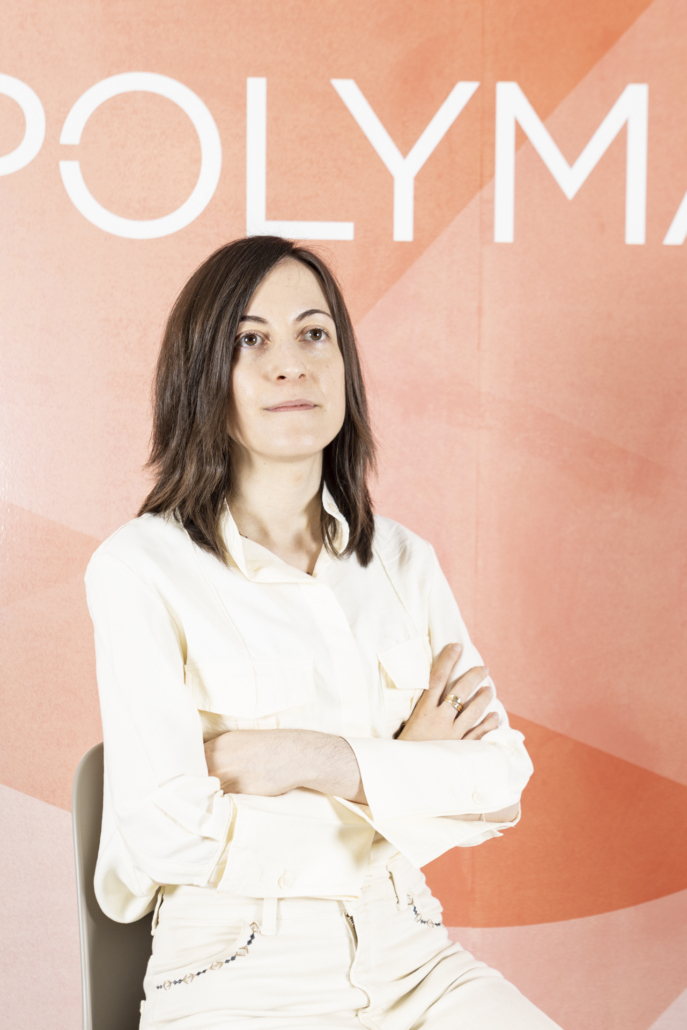
Ainara Sangroniz Agudo is an Assistant Professor at POLYMAT and the University of the Basque Country, where she leads the Sustainable Materials for Food Packaging research group.
She obtained her BSc in Chemistry (2014) and MSc in Chemistry and Polymers (2015) from the University of the Basque Country. She completed her PhD at the same institution in 2020 with the support of a competitive Basque Government fellowship.
In 2021, she was awarded a postdoctoral fellowship from the Basque Government (1st position) to join the research group of Eugene Y.X. Chen at Colorado State University. That same year, she received the prestigious Marie Skłodowska-Curie Individual Fellowship from the European Union, allowing her to continue her research at Colorado State University. During her postdoctoral training, she specialized in polymer chemistry and the development of sustainable polymeric materials, publishing in leading international journals and working with universities and industrial partners focused on developing a circular economy for plastics.
In January 2023, she obtained a position as Assistant Professor at the University of the Basque Country and POLYMAT to start her independent career. Her research focuses on the design and development of advanced sustainable materials for food packaging, addressing the environmental challenges associated with conventional plastics. Her group investigates structure-property relationships that determine key functional properties, particularly gas and vapor barrier performance, with the goal of developing high-performance, recyclable, and sustainable packaging materials. By integrating fundamental polymer science with application-driven research, her team seeks innovative strategies to reduce plastic waste while meeting the demanding requirements of modern food packaging.
Her research excellence has been recognized through several competitive awards, including the Extraordinary PhD Thesis Award from the University of the Basque Country and the CAF-Elhuyar Award. She has also been awarded a six-year research period ("sexenio de investigación") recognized by ANECA.
Tacticity-independent crystallization of polymers
L. Sangroniz, A. Sangroniz, C. Shi, M. Scoti, M. Ximenis, C. De Rosa, E. Chen, H. Sardon and A.J. Müller
From process design to application: kinetics, techno-economic assessment, and polymerization of biomass-derived 1,5-pentanediol
Barredo Vinuesa A., Valle A., Requies J.M., Alam M.S., Sangroniz A., Agirre I. and Gandarias I.
High-Molecular-Weight Isodimorphic Copolyesters with Tunable Ductility, Barrier Performance, and Adhesive Behavior
Torres-Rodríguez J., Pérez-Camargo R.A., Vidal F., Mantione D., Martínez de Ilarduya A., Aranburu N., Otaegi I., Calafel M.I., Fernandez M., Alam M.S., Sangroniz A., Sardon H. and A.J. Müller
Lab safety alert: a real case of isocyanate exposure
A. Prasad, G. Perli, M. Ximenis, A. Tejero, A. Mugica, L. Fonseca, A. Sangroniz, F. Vidal and H. Sardon
Fungal Chitin Nanofibrils to Improve the Functional Properties of Poly(vinyl alcohol) Films for Sustainable Food Packaging
M. Alam, L. Sangroniz, M. Scoti, A. González, A. Etxeberría, A. Sangroniz and E. Lizundia
Sustainable Structural Hot-Melt Adhesives Enabled by Functionalized Crystalline Lamellae
Z. Hu, A. Wolff, Y. Zhao, E. Rettner, M. Alam, A. Sangroniz and G. Miyake
Terpenoid-based high-performance polyester with tacticity-independent crystallinity and chemical circularity
Z. Hu, S. Bernsten, C. Shi, A. Sangroniz, E. Chen and G. Miyake
Chain-End Controlled Depolymerization Selectivity in a,a-Disubstituted Propionate PHAs with Dual Closed-Loop Recycling and Record-High Melting Temperature
L. Zhou, Z. Zhang, A. Sangroniz, C. Shi, R. Gowda, M. Scoti, D. Barange, C. Lincoln, G. Beckham and E. Chen
Metal-free initiators pave the way for chemically recyclable polymers with industrially relevant properties
A. Sangroniz and H. Sardon
Lactide-valerolactone copolymers for packaging applications
Sangroniz A., Sangroniz L., Hamzehlou S., Aranburu N., Sardon H., J.R. Sarasua, Iriarte M., J.R. Leiza and Etxeberria A.
Modulating the Crystallinity of a Circular Plastic towards Packaging Material with Outstanding Barrier Properties
Sangroniz A., J. Zhu, Etxeberria A., E. Chen and Sardon H.
Installing Controlled Stereo-Defects Yields Semicrystalline and Biodegradable Poly(3-Hydroxybutyrate) with High Toughness and Optical Clarity
E. Quinn, A. Westlie, A. Sangroniz, M. Caputo, S. Xu, Z. Zhang, M. Urgun-Demirtas, A.J. Müller and E. Chen
Poly(hydroxy acids) derived from the self-condensation of hydroxy acids: from polymerization to end-of-life options (vol 11, pg 4861, 2020)
E. Gabirondo, A. Sangroniz, A. Etxeberria, S. Torres-Giner and H. Sardon
Poly(hydroxy acids) derived from the self-condensation of hydroxy acids: from polymerization to end-of-life options
E. Gabirondo, A. Sangroniz, A. Etxeberria, S. Torres-Giner and H. Sardon
Chemical Structure Drives Memory Effects in the Crystallization of Homopolymers
L. Sangroniz, A. Sangroniz, L. Meabe, A. Basterretxea, H. Sardon, D. Cavallo and A.J. Müller
Lactide-caprolactone copolymers with tuneable barrier properties for packaging applications
A. Sangroniz, L. Sangroniz, S. Hamzehlou, J. Río, A. Santamaria, J.R. Sarasua, M. Iriarte, J.R. Leiza and A. Etxeberria
Blends based on biodegradable poly(caprolactone) with outstanding barrier properties for packaging applications: The role of free volume and interactions
M. Corres, Á. Mayor, A. Sangroniz, J. del Río, M. Iriarte and A. Etxeberria
Upgrading Recycled Polyolefins as Stimuli Responsive Materials
L. Sangroniz, A. Sangroniz, M. Fernandez, A. Etxeberria, A.J. Müller and A. Santamaria

