
A Versatile Platform for Polymer Foaming
Polímeros y sostenibilidad
Background
Polymer foams are widely used in insulation, packaging and lightweight components. Their manufacture requires careful coordination of gas generation and polymer curing. A versatile foaming approach compatible with different resin chemistries would expand the range of available materials and enable alternatives to conventional isocyanate-based foams.
Invention
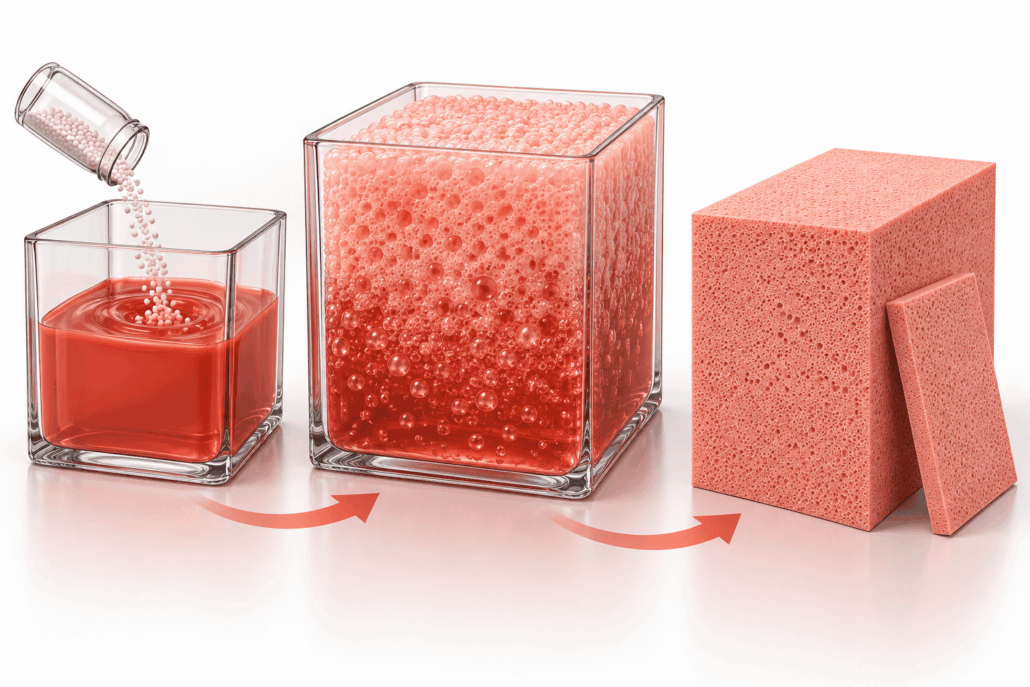
This technology uses N-carboxyanhydrides (NCAs) as reactive blowing agents for polymer foam production. Upon reaction with a nucleophile, these compounds release CO₂ to generate the cellular structure, while the resulting amine can become incorporated into the polymer network.
The platform is compatible with different polymer chemistries, including epoxy, polyamide, polyimide and non-isocyanate polyurethane systems. Resin selection and formulation allow foam properties to be tailored, including formulations with high biobased content. Room-temperature foaming and curing have been demonstrated for selected epoxy formulations.
Potential Applications
- Lightweight cores for sandwich panels and structural composites.
- Thermal and acoustic insulation.
- Protective packaging and cushioning.
- Lightweight moulded components for automotive, construction and other industrial applications.
Key Benefits
- Versatile blowing-agent platform compatible with multiple polymer chemistries.
- CO₂ generation coupled with polymer formation.
- Low blowing-agent loadings of 1–3 wt% in demonstrated formulations.
- Enables isocyanate-free foams through suitable resin and hardener combinations.
- Tunable foam density, cellular morphology and thermomechanical properties.
- Compatible with commercial resin precursors and biobased formulations.
IPR Status
Published international patent application: WO2026201974 A1.
